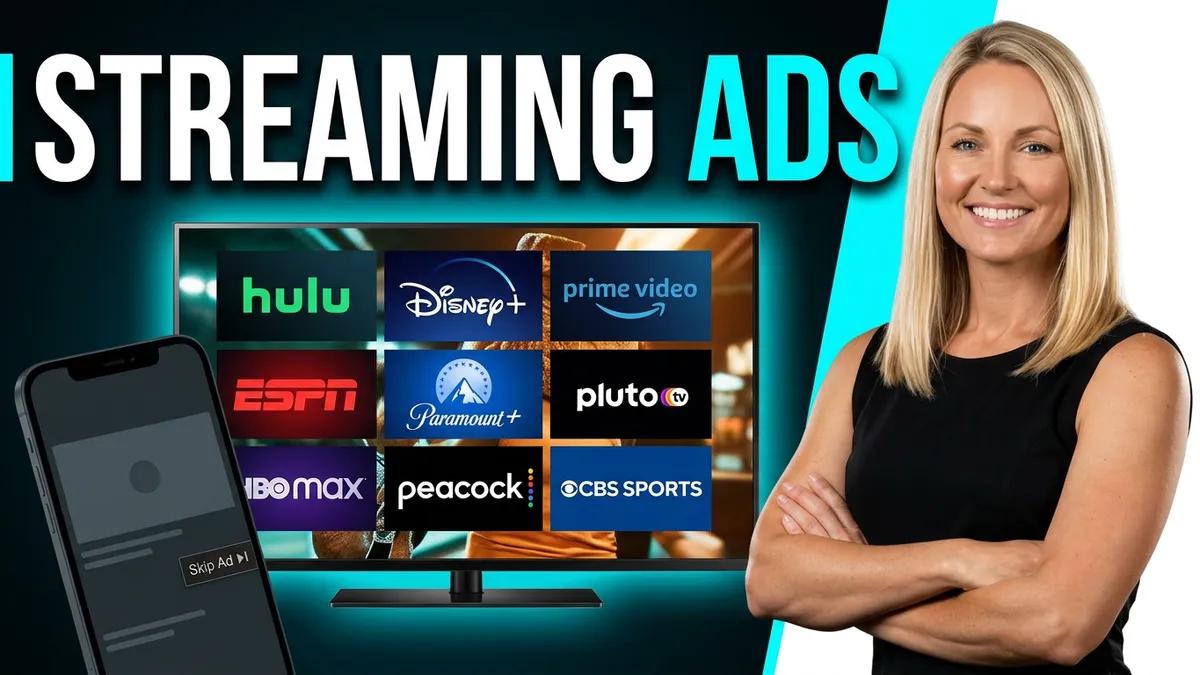
Streaming TV Ads
Streaming TV Advertising: How Local Businesses Can Reach Customers Where They’re Actually Watching
For decades, television advertising was one of the most powerful ways for a business to reach a large audience.
It was also expensive.
If a local business wanted to advertise on television, the traditional options usually meant buying commercial time on local broadcast or cable networks, paying for a large audience whether those viewers were potential customers or not, and committing a significant portion of the marketing budget to a relatively broad audience.
But television has changed.
Today, millions of people are watching television through streaming services rather than traditional cable or satellite. And that shift has created an opportunity that wasn't available to most local businesses just a few years ago:
You can put a professionally produced commercial on the television screen in your customer's home—and target who sees it.
This is commonly referred to asStreaming TV advertising, Connected TV advertising, or CTV advertising.
And for many local businesses, it can be a powerful addition to an overall video marketing strategy.
What Is Streaming TV Advertising?
Streaming TV advertising is essentially television advertising delivered through internet-connected television and streaming platforms.
Instead of buying a traditional commercial spot based primarily on a television station, network, program, or time slot, streaming advertising allows advertisers to use audience and geographic data to determine who should receive the advertisement.
The viewer might be watching a show through a streaming service, a smart TV, a Roku or Fire TV device, or another connected television platform. The commercial appears as part of the normal advertising experience.
From the viewer's perspective, it looks and feels like a television commercial.
From the advertiser's perspective, however, the process behind that commercial is much more targeted and measurable.
CTV advertising can use geographic, demographic, behavioral, and audience targeting rather than simply buying a broad television market.
That distinction is incredibly important for local businesses.
Television Advertising Is No Longer Just for Big Companies
There was a time when the phrase "TV advertising" probably made a small-business owner think:
"That's way too expensive for us."
And traditionally, that assumption made sense.
A local business could end up paying to expose its commercial to thousands of people who had absolutely no reason to become a customer.
A roofing company doesn't need to reach everyone watching television in an entire metropolitan area.
A dentist doesn't need to advertise to every household.
A law firm doesn't necessarily need to reach every person watching the local news.
A restaurant doesn't need to reach people who live hundreds of miles away.
What these businesses need isthe right people in the right geographic area to see the right message.
Streaming TV makes that kind of strategy much more accessible.
Instead of thinking about television as simply "buying viewers," businesses can think about it asbuilding an audience and delivering a video message to that audience on the biggest screen in the home.
Why Streaming TV Is Different From Social Media Advertising
Social media advertising is extremely powerful, and there is no reason to abandon it.
Facebook, Instagram, YouTube, and other digital platforms can be excellent places to reach prospective customers.
But there is an important difference between someone scrolling through a social-media feed and someone sitting on the couch watching television.
When someone is scrolling through Instagram or Facebook, your advertisement is competing with everything else on the screen.
Another post.
A text message.
A notification.
A funny video.
A news story.
A friend's vacation photos.
Your ad has to interrupt that scrolling behavior and earn attention almost immediately.
Streaming TV is a fundamentally different environment.
Your commercial can appearfull-screen on the television while someone is actually watching a program.
That doesn't mean every streaming TV viewer will suddenly become a customer. Advertising doesn't work that way.
But it does give your business another opportunity to build awareness and credibility in an environment that feels much more like traditional television.
And importantly, streaming TV and social media don't have to compete with each other.
They can work together.
A viewer might see your commercial on their television and later encounter your company again on Facebook or Instagram. They might visit your website. They might search for your business. They might see another video.
That's how a broader video marketing campaign begins to create multiple touchpoints with the same potential customer.
Where Can Streaming TV Ads Appear?
One of the biggest misconceptions about streaming advertising is that you have to pick one streaming service and hope your customers happen to be watching it.
That's not necessarily how modern programmatic CTV campaigns work.
Depending on the advertising platform and campaign strategy, inventory can be available across a wide range of streaming services, connected-TV environments, and ad-supported channels.
That can include platforms and services such as Hulu, Disney+, Peacock, Paramount+, Roku, Tubi, Pluto TV and many others. The exact inventory available depends on the media-buying platform, audience, geography, and campaign.
This creates an important strategic advantage.
You're not necessarily trying to guess which individual streaming service your customer uses.
Instead, the goal is to identify your target audience and deliver the commercial across the available streaming inventory where those people are watching.
The Real Power: Targeting
This is where Streaming TV gets particularly interesting for local businesses.
Imagine you own a business in the Myrtle Beach area.
You don't necessarily want your commercial shown to someone living three states away.
You want to reach people who can actually become customers.
Depending on the campaign, CTV advertising can be targeted geographically and layered with additional audience characteristics. Geographic targeting can include markets, ZIP codes, service areas, and other defined geographic parameters, while audience targeting can incorporate demographic and behavioral characteristics.
That means your advertising strategy can start with a much more important question than:
"How many people can we reach?"
Instead, you can ask:
"Which people are most likely to become our customers?"
That is a much better marketing question.
Think About Your Ideal Customer
Before creating a streaming TV commercial, you should know who you're trying to reach.
For example, imagine you're a high-end home remodeling company.
Your potential audience might include homeowners in specific communities who have the financial ability to invest in a major renovation.
Or perhaps you're a medical practice.
Your audience might be people within a certain geographic radius who fit particular demographic characteristics.
A restaurant might want to reach people living nearby who are likely to dine out.
A tourism business might want to reach potential visitors outside the immediate market.
A golf resort might want to reach affluent households in specific regions.
A home-services company might want to reach homeowners within its service area.
The commercial itself is only one part of the equation.
The audience strategy determines who gets the opportunity to see it.
How Much Does Streaming TV Advertising Cost?
One of the most common questions we hear is:
"How much does it cost to advertise on streaming TV?"
The answer is: it depends.
There are two separate costs to consider.
1. Producing the commercial
You need a video advertisement that represents your business professionally and communicates a compelling message.
Depending on the business, this could be a relatively straightforward production or a larger commercial campaign involving locations, talent, scripting, lighting, multiple cameras, special equipment, animation, or other production requirements.
2. Distributing the commercial
You then need a media budget to actually put that commercial in front of viewers.
The good news is that streaming TV doesn't necessarily require the enormous media budgets traditionally associated with television advertising.
In the video accompanying this article, we discuss campaigns beginning around$50 per day. The appropriate budget for your business, however, depends on your geographic market, audience size, campaign objectives, desired frequency, and the media-buying platform being used.
The important thing is to stop thinking about the commercial as the entire investment.
Producing the video without having a plan for getting people to see it defeats the purpose.
The Distribution Gap
This is one of the biggest problems we see in video marketing.
A business spends thousands of dollars producing a beautiful video.
Everyone loves it.
It gets posted to Facebook.
Maybe it gets posted to Instagram.
Then it sits there.
And eventually, the business owner wonders:
"Why isn't this video generating more business?"
The problem may not be the video.
The problem may bedistribution.
A great commercial that nobody sees can't generate much of a return.
That's why Kinetic Media Productions approaches video differently.
We don't believe the goal should simply be to create a beautiful video file.
The goal should be to create astrategic marketing asset that gets in front of the right people and encourages them to take action.
That's a very different approach.
Your Commercial Needs to Be Built for the Medium
Putting a video on streaming TV doesn't automatically make it an effective streaming TV advertisement.
The creative matters.
A lot.
A typical streaming TV commercial may only have 15 or 30 seconds to accomplish several things:
Get the viewer's attention.
Establish who you are.
Communicate the problem or opportunity.
Explain your value.
Give the viewer a reason to care.
Tell them what to do next.
That's a lot to accomplish in a short amount of time.
The commercial therefore needs to be strategically written and produced.
Beautiful cinematography is valuable.
Professional lighting is valuable.
Great sound is valuable.
But none of those things matter if the viewer doesn't understandwhy your business matters to them.
The creative strategy has to come first.
Streaming TV Isn't Just About Getting Views
One of the biggest mistakes businesses make with video marketing is focusing exclusively on views.
Views are nice.
But businesses don't pay their employees with views.
They pay them with revenue.
That's why we encourage businesses to think beyond vanity metrics.
Depending on your business and campaign, you might ultimately care about:
Website visits
Phone calls
Form submissions
Discovery calls
Store visits
Appointment requests
Leads
Sales
Bookings
Revenue
The objective should determine the campaign.
For example, a local service business might use streaming TV primarily to build awareness and generate qualified leads.
A tourism business might use it to generate interest in a destination and ultimately drive bookings.
A retail business might use it to drive customers into a physical location.
A professional service firm might use it to establish credibility before someone ever contacts the company.
The strategy changes depending on the business.
Streaming TV + Social Media Can Be More Powerful Together
There's no reason your marketing strategy needs to choose between streaming TV and social media.
In fact, one of the best approaches can be to use them together.
Think of the customer journey this way:
Streaming TV → Awareness → Social Media → Website → Retargeting → Conversion
A person might first encounter your company while watching television.
Later, they may see your company again on Instagram.
Then they visit your website.
Then they receive an email.
Then they finally make the phone call.
Consumers don't always buy the first time they see an advertisement.
Marketing is often about building familiarity and trust over multiple interactions.
That's one reason we believe video should be treated as part of a larger marketing system rather than as a standalone production.
Who Should Consider Streaming TV Advertising?
Streaming TV can be particularly interesting for businesses that have a defined geographic market and a customer with meaningful lifetime value.
That can include:
Home-service companies
Attorneys
Medical and dental practices
Financial services
Real estate companies
Automotive businesses
Restaurants
Retailers
Resorts and hotels
Golf courses
Attractions
Tourism organizations
Fitness businesses
Construction companies
Professional services
Higher-end consumer products
But the real question isn't whether your industry appears on this list.
The better question is:
Can reaching the right audience repeatedly create enough business value to justify the campaign?
If the answer is yes, streaming TV may deserve a place in your marketing strategy.
What Makes a Streaming TV Campaign Successful?
A successful campaign isn't simply:
Make commercial → Put commercial on TV → Hope.
A better process looks something like this:
Step 1: Identify the business objective
What are you trying to accomplish?
More leads?
More sales?
More appointments?
More bookings?
Greater awareness?
Step 2: Define the audience
Who is most likely to buy?
Where do they live?
What characteristics define them?
What problem are they trying to solve?
Step 3: Develop the message
What should this audience know, feel, or do after seeing the commercial?
Step 4: Produce the creative
Create a professional 15- or 30-second commercial designed specifically for the campaign.
Step 5: Build the media strategy
Determine the geographic area, audience, budget, frequency, and available streaming inventory.
Step 6: Launch
Put the commercial in front of the target audience.
Step 7: Measure
Monitor campaign performance and determine whether the advertising is contributing to the desired business outcome.
Step 8: Optimize
Adjust the campaign when the data shows an opportunity to improve performance.
That's marketing.
And that's very different from simply producing a video.
Why Kinetic Media Productions Approaches Video Differently
At Kinetic Media Productions, we believe businesses need more than "pretty footage."
Our approach is built around a simple idea:
Video should help solve a business problem.
Our current business offering combines commercial video production with performance-marketing strategy, with campaigns designed around goals such as lead generation, sales, foot traffic, bookings, and regional growth.
That means we want to understand the business before we start talking about cameras.
Who are you trying to reach?
What are you trying to accomplish?
Where will the video be seen?
What action do you want people to take?
What happens after someone responds to the advertisement?
Those questions are just as important as what camera we're going to use.
Because ultimately, the goal isn't to hand you a video file.
The goal is to put your business in front of the right people and help turn attention into action.
Ready to Put Your Business on Streaming TV?
Streaming TV has changed what is possible for local businesses.
You don't necessarily need a massive corporate advertising budget to put a professionally produced commercial on the television screen.
You don't have to advertise to everyone in an entire television market.
And you don't have to choose between television and digital marketing.
With the right strategy, streaming TV can become another powerful component of a broader video marketing campaign.
At Kinetic Media Productions, we combine professional commercial production with a distribution-first approach designed around your business goals.
Because we don't believe in creating videos just to get views.
We create strategic video campaigns designed to help businesses generate leads, increase sales, and grow.
If you're a business owner, marketing manager, or decision-maker in the Myrtle Beach area and you're interested in exploring whether Streaming TV advertising could work for your business,let's talk about your goals and build a strategy around them.